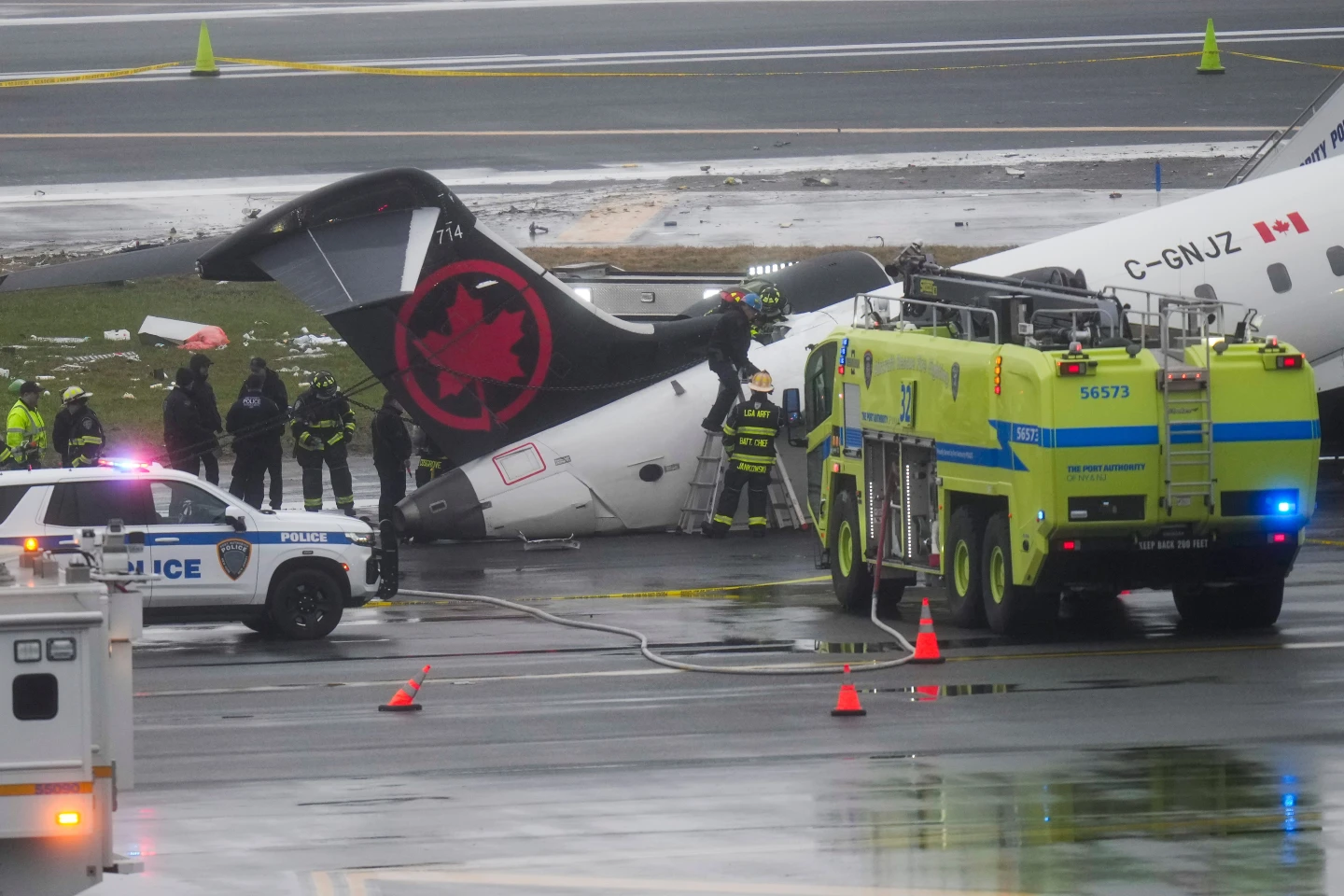
Federal investigators revealed alarming deficiencies that led to a fatal collision between a regional jet and a fire truck at New York's LaGuardia Airport last month. The National Transportation Safety Board (NTSB) highlighted that the fire truck failed to obey stop signals and was not equipped with a transponder, which hindered the airport's collision warning systems. Air traffic was unusually heavy due to delays, complicating controller duties as they scrambled to manage an unrelated emergency with another aircraft.
The incident occurred on March 22, when Air Canada Express Flight 8646, arriving from Montreal with 76 people onboard, struck the fire truck shortly after landing. The two pilots, Antoine Forest and Mackenzie Gunther, tragically lost their lives, while 39 others, including the crew in the fire vehicle, sustained various injuries. This marked the first fatal crash at LaGuardia in over three decades.
According to the NTSB report, two air traffic controllers were managing an unusually high volume of aircraft when the incident occurred. The advanced radar system at LaGuardia, which is supposed to alert controllers of potential collisions, struggled to identify the moving fire truck and other vehicles due to their lack of transponders, making it challenging to track their movements effectively.
Additionally, crucial red warning lights intended to alert vehicles of active runways were illuminated at the time of the collision. Despite this, the fire truck was cleared to cross the runway, a decision that has drawn significant scrutiny from aviation experts. The last-minute communication from the controller, instructing the truck to stop, came perilously close to the moment of impact, illustrating potential miscommunication in a high-stakes environment. Experts have debated whether the truck's speed would allow it to halt in time, further questioning the adequacy of current safety protocols at busy airports.
This event raises significant concerns regarding aviation safety regulations and the checks and balances in place to protect lives in the complex environment of air traffic management.
The incident occurred on March 22, when Air Canada Express Flight 8646, arriving from Montreal with 76 people onboard, struck the fire truck shortly after landing. The two pilots, Antoine Forest and Mackenzie Gunther, tragically lost their lives, while 39 others, including the crew in the fire vehicle, sustained various injuries. This marked the first fatal crash at LaGuardia in over three decades.
According to the NTSB report, two air traffic controllers were managing an unusually high volume of aircraft when the incident occurred. The advanced radar system at LaGuardia, which is supposed to alert controllers of potential collisions, struggled to identify the moving fire truck and other vehicles due to their lack of transponders, making it challenging to track their movements effectively.
Additionally, crucial red warning lights intended to alert vehicles of active runways were illuminated at the time of the collision. Despite this, the fire truck was cleared to cross the runway, a decision that has drawn significant scrutiny from aviation experts. The last-minute communication from the controller, instructing the truck to stop, came perilously close to the moment of impact, illustrating potential miscommunication in a high-stakes environment. Experts have debated whether the truck's speed would allow it to halt in time, further questioning the adequacy of current safety protocols at busy airports.
This event raises significant concerns regarding aviation safety regulations and the checks and balances in place to protect lives in the complex environment of air traffic management.