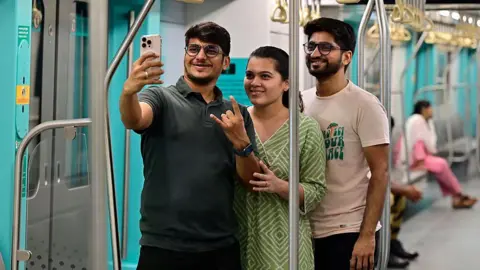
On an evening in Mumbai, the Aqua Line metro train, which connects prominent city areas, saw a dishearteningly sparse crowd. The train approached a final station that felt more akin to a derelict Soviet structure than the bustling hub expected in a dynamic financial center.
Opened last year, the Aqua Line was projected to alleviate congestion in Mumbai, with estimates for daily passengers reaching nearly 1.5 million. However, current ridership stands at merely a tenth of that number. A ticketing executive cited that the fares are too steep, discouraging potential commuters.
This trend of low ridership is emblematic of a broader dilemma impacting India's rapid metro expansion. The Modi government has invested over $26 billion since 2014 to enhance metro connectivity across nearly two dozen cities, resulting in a growth from under 300 km to over 1,000 km by 2025. While average daily ridership increased from three million to over eleven million over the past decade, many metro systems still fall far short of their anticipated passenger numbers.
An IIT Delhi report indicates that actual ridership often hovers between 25-35% of initial projections, suggesting minimal change is anticipated for the coming years. Other cities have faced similar challenges; for instance, Kanpur's metro ridership dropped to just 2% of forecasts, while Chennai's was 37% for its initial phase.
Surprisingly, the capital city, Delhi, is one of the few exceptions where usage slightly exceeds projections, primarily due to a change in the method of counting trips, which now includes interchanges.
The challenges contributing to low metro ridership revolve around multiple factors. Poor projections of potential demand, increased costs for commuters, and insufficient last-mile connectivity inhibit public transportation adoption.
For lower-income workers, the journey can take up nearly 20% of their income, surpassing the global benchmark of 10-15%. A comparison to Mumbai's suburban railway reveals a significant fare disparity— a minimal cost of 590 rupees (~$7) for a three-month unlimited pass compared to higher fares on the metro.
Additionally, operational factors like infrequent train services and inadequate feeder buses exacerbate the situation. For example, interruptions between lines can take up to 15-20 minutes.
Yet, despite substantial hurdles, experts predict a gradual increase in metro usage fueled by worsening traffic and rising pollution levels. To drive significant growth in user adoption, a seamless ride combined with affordability and enhanced connection to other transport must be realized. In the absence of such improvements, India's ambitious metro endeavors might continue to underperform compared to initial projections.
Opened last year, the Aqua Line was projected to alleviate congestion in Mumbai, with estimates for daily passengers reaching nearly 1.5 million. However, current ridership stands at merely a tenth of that number. A ticketing executive cited that the fares are too steep, discouraging potential commuters.
This trend of low ridership is emblematic of a broader dilemma impacting India's rapid metro expansion. The Modi government has invested over $26 billion since 2014 to enhance metro connectivity across nearly two dozen cities, resulting in a growth from under 300 km to over 1,000 km by 2025. While average daily ridership increased from three million to over eleven million over the past decade, many metro systems still fall far short of their anticipated passenger numbers.
An IIT Delhi report indicates that actual ridership often hovers between 25-35% of initial projections, suggesting minimal change is anticipated for the coming years. Other cities have faced similar challenges; for instance, Kanpur's metro ridership dropped to just 2% of forecasts, while Chennai's was 37% for its initial phase.
Surprisingly, the capital city, Delhi, is one of the few exceptions where usage slightly exceeds projections, primarily due to a change in the method of counting trips, which now includes interchanges.
The challenges contributing to low metro ridership revolve around multiple factors. Poor projections of potential demand, increased costs for commuters, and insufficient last-mile connectivity inhibit public transportation adoption.
For lower-income workers, the journey can take up nearly 20% of their income, surpassing the global benchmark of 10-15%. A comparison to Mumbai's suburban railway reveals a significant fare disparity— a minimal cost of 590 rupees (~$7) for a three-month unlimited pass compared to higher fares on the metro.
Additionally, operational factors like infrequent train services and inadequate feeder buses exacerbate the situation. For example, interruptions between lines can take up to 15-20 minutes.
Yet, despite substantial hurdles, experts predict a gradual increase in metro usage fueled by worsening traffic and rising pollution levels. To drive significant growth in user adoption, a seamless ride combined with affordability and enhanced connection to other transport must be realized. In the absence of such improvements, India's ambitious metro endeavors might continue to underperform compared to initial projections.