In brief
Researchers have documented a brutal internal conflict among the Ngogo chimpanzees in Uganda's Kibale National Park, persisting for eight years and resulting in significant casualties. Once a close-knit community, the group has become divided, with numerous fatalities, especially among infants. This unfolding drama sheds light on the complexity of social interactions among primates and prompts reevaluation of human conflict origins.
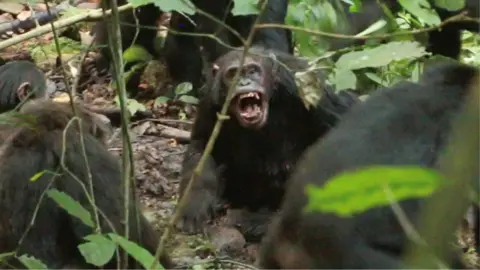
The world's largest group of wild chimpanzees, located in Uganda's Kibale National Park, is currently embroiled in a vicious 'civil war', researchers report. This split has led to a significant escalation in violence over the past eight years, with scientists recording 24 individual killings, including 17 infant deaths.
Lead researcher Aaron Sandel noted a drastic behavioral shift: “These were chimps that would hold hands; now they're trying to kill each other.” The study, published in the journal Science, suggests the violent dynamics among these chimpanzees could provide insight into the origins of human conflict.
According to Sandel, the chimpanzees were earlier known for their harmonious interactions, living as a cohesive group divided into two sets: Western and Central. Disturbances began in 2015, culminating in the separation of the two factions in 2018. This resulted in aggressive skirmishes, primarily instigated by the Western group against the Central group.
Several factors contribute to this hostile environment, notably the deaths of key individuals in the group, changes in leadership, and increased competition for resources—which altogether have fostered a climate of fear and aggression.
Sandel explains that the findings compel us to reconsider human societal conflicts, noting, “In the case of the Ngogo fission, individuals who lived, fed, and groomed together for years became targets of lethal attacks on the basis of their new group membership.” This research invites reflection on the dynamics of intergroup violence across species lines, underlining the importance of social structures in both human and animal societies.