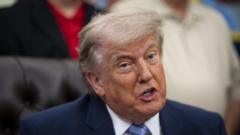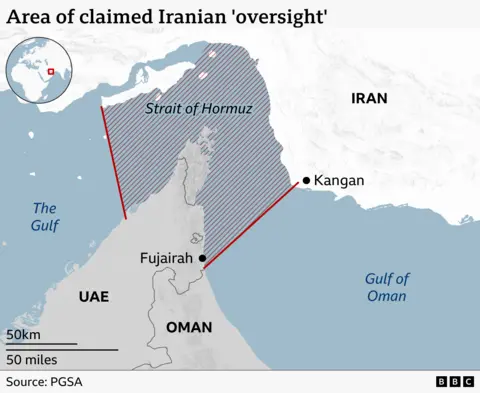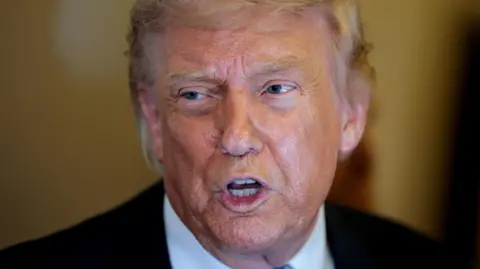
Major stock markets in Asia slumped on Monday after Washington and Tehran threatened to intensify hostilities, as the Iran war enters its fourth week. Japan's benchmark Nikkei 225 index was 3.4% lower in morning trade, while South Korea's Kospi fell by almost 5%. US President Donald Trump warned on Saturday that he would obliterate Iranian power plants if Iran did not open the key Strait of Hormuz shipping route. Iran responded by threatening to target key infrastructure in the region, including energy facilities.
Japan and South Korea have been particularly impacted by the conflict, as they are heavily dependent on oil and gas that would normally pass through the strait. Iran has effectively blocked the Strait of Hormuz, one of the world's busiest oil shipping channels, since the US and Israel attacked the country on 28 February.
About 20% of the world's oil and liquefied natural gas (LNG) usually passes through the waterway - and the war has sent global fuel prices soaring. International Energy Agency chief Fatih Birol warned on Monday that the conflict could lead to the world facing its worst energy crisis in decades, drawing comparisons to crises during the 1970s and the fallout of Russia's 2022 invasion of Ukraine.
This crisis as things stand is now two oil crises and one gas crash put all together, said Birol. On Monday, international markets continued to feel the strain - Hong Kong's Hang Seng index was down by 2.5%, while Taiwan's Weighted Index lost 2%. Meanwhile, global oil prices mostly held steady, with Brent crude slightly lower at $112 a barrel.
Japan and South Korea have been particularly impacted by the conflict, as they are heavily dependent on oil and gas that would normally pass through the strait. Iran has effectively blocked the Strait of Hormuz, one of the world's busiest oil shipping channels, since the US and Israel attacked the country on 28 February.
About 20% of the world's oil and liquefied natural gas (LNG) usually passes through the waterway - and the war has sent global fuel prices soaring. International Energy Agency chief Fatih Birol warned on Monday that the conflict could lead to the world facing its worst energy crisis in decades, drawing comparisons to crises during the 1970s and the fallout of Russia's 2022 invasion of Ukraine.
This crisis as things stand is now two oil crises and one gas crash put all together, said Birol. On Monday, international markets continued to feel the strain - Hong Kong's Hang Seng index was down by 2.5%, while Taiwan's Weighted Index lost 2%. Meanwhile, global oil prices mostly held steady, with Brent crude slightly lower at $112 a barrel.