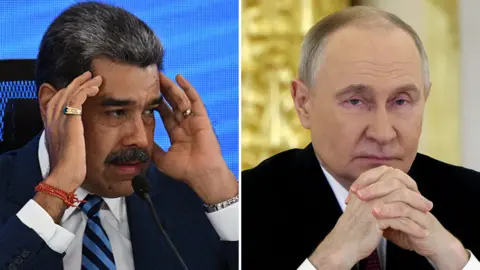
Vladimir Putin may have a reputation among some as a ruthless autocrat, a master manipulator of the international scene. But one thing Russia's president does not have is a poker face. The late US Senator John McCain used to joke that when he looked into Putin's eyes, he saw three things, 'a K and a G and a B', a reference to his past life as a Soviet intelligence officer.
I thought of this as I watched footage of Russia's leader sitting opposite American envoys in the Kremlin. He could not hide his emotions; he exuded an air of supreme confidence.
For President Putin reckons the diplomatic tide has turned in his favour, with an improved relationship with America and gains on the battlefield.
Some analysts say Putin has no incentive to retreat from his demands: that Ukraine gives up the last 20% of Donetsk it still controls; that all occupied territory is recognised internationally as Russian; that Ukraine's army is curtailed to a point of impotence; and NATO membership is ruled out forever.
As things stand, there are a few possible scenarios. The first is that US President Donald Trump may try to force Ukraine into a ceasefire on terms unwelcome to its people, one that cedes territory and lacks sufficient security guarantees to deter future Russian aggression.
If Ukraine demurs or Russia vetoes, President Trump has hinted he could wash his hands of the war; last week, he said 'sometimes you have to let people fight it out'. He could remove the vital US intelligence Ukraine needs to detect incoming Russian drones and target Russian energy facilities.
Another possibility is that the war could just stumble on with Russia's forces continuing to make slow advances in the east. The Trump administration's new national security strategy implied that Russia is no longer an 'existential threat' to the US, and urged the US to 're-establish strategic stability' with Russia.
So, with American support for Ukraine in serious question, what - if anything - could potentially change Putin's mind? And what else could Ukraine, Europe and even China, do differently?
At the moment, the continent is preparing for a ceasefire. Under the banner of the 'coalition of the willing', it is preparing an international military force to help Ukraine deter future Russian invasion, alongside a financial effort to help reconstruct the war-ravaged country.
But some officials suggest that Europe should instead prepare for the war to muddle on. They want to help Ukraine not only 'win the fight tonight', with more drones and cash; but also provide longer term support and prepare for a 15 to 20 year war with Russia.
Ukraine could mobilise more of its armed forces, as it remains the second-biggest army in Europe but is struggling to defend an 800-mile frontline. After almost four years of war, many soldiers are exhausted, with rising desertion rates.
Then there's the economic lever through sanctions; while Russia's economy is suffering, it hasn't changed Kremlin thinking much, as businesses have found ways of evading restrictions. According to reports, Russia seized only 1% of Ukrainian territory this year, at an enormous cost in lives lost.
In exploring a potential diplomatic path, analysts argue that offering Putin a way out of the war might influence his decision-making. Aligning U.S. engagement with assertive diplomacy could create possibilities for negotiations.
Lastly, despite the current dynamics with China, if Beijing decided to apply pressure on Moscow, it could significantly impact the Kremlin's strategy as Russia relies heavily on Chinese support.
The overarching challenge remains: as the war continues, there may not be immediate changes in Putin's calculus unless substantial shifts in the geopolitical landscape occur.
I thought of this as I watched footage of Russia's leader sitting opposite American envoys in the Kremlin. He could not hide his emotions; he exuded an air of supreme confidence.
For President Putin reckons the diplomatic tide has turned in his favour, with an improved relationship with America and gains on the battlefield.
Some analysts say Putin has no incentive to retreat from his demands: that Ukraine gives up the last 20% of Donetsk it still controls; that all occupied territory is recognised internationally as Russian; that Ukraine's army is curtailed to a point of impotence; and NATO membership is ruled out forever.
As things stand, there are a few possible scenarios. The first is that US President Donald Trump may try to force Ukraine into a ceasefire on terms unwelcome to its people, one that cedes territory and lacks sufficient security guarantees to deter future Russian aggression.
If Ukraine demurs or Russia vetoes, President Trump has hinted he could wash his hands of the war; last week, he said 'sometimes you have to let people fight it out'. He could remove the vital US intelligence Ukraine needs to detect incoming Russian drones and target Russian energy facilities.
Another possibility is that the war could just stumble on with Russia's forces continuing to make slow advances in the east. The Trump administration's new national security strategy implied that Russia is no longer an 'existential threat' to the US, and urged the US to 're-establish strategic stability' with Russia.
So, with American support for Ukraine in serious question, what - if anything - could potentially change Putin's mind? And what else could Ukraine, Europe and even China, do differently?
At the moment, the continent is preparing for a ceasefire. Under the banner of the 'coalition of the willing', it is preparing an international military force to help Ukraine deter future Russian invasion, alongside a financial effort to help reconstruct the war-ravaged country.
But some officials suggest that Europe should instead prepare for the war to muddle on. They want to help Ukraine not only 'win the fight tonight', with more drones and cash; but also provide longer term support and prepare for a 15 to 20 year war with Russia.
Ukraine could mobilise more of its armed forces, as it remains the second-biggest army in Europe but is struggling to defend an 800-mile frontline. After almost four years of war, many soldiers are exhausted, with rising desertion rates.
Then there's the economic lever through sanctions; while Russia's economy is suffering, it hasn't changed Kremlin thinking much, as businesses have found ways of evading restrictions. According to reports, Russia seized only 1% of Ukrainian territory this year, at an enormous cost in lives lost.
In exploring a potential diplomatic path, analysts argue that offering Putin a way out of the war might influence his decision-making. Aligning U.S. engagement with assertive diplomacy could create possibilities for negotiations.
Lastly, despite the current dynamics with China, if Beijing decided to apply pressure on Moscow, it could significantly impact the Kremlin's strategy as Russia relies heavily on Chinese support.
The overarching challenge remains: as the war continues, there may not be immediate changes in Putin's calculus unless substantial shifts in the geopolitical landscape occur.