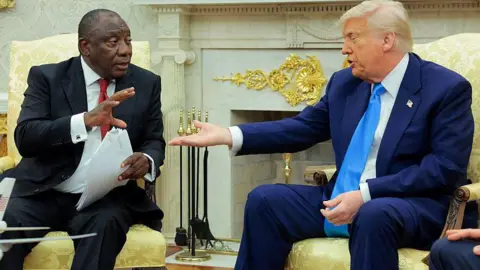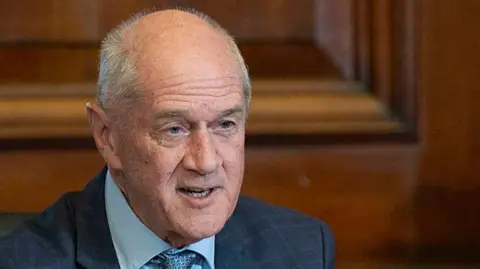
South Africa's President Cyril Ramaphosa has appointed Roelf Meyer, who served in the last government of the apartheid era, as his new ambassador to the US, his office has said. The country has not had a top envoy in the US since Ebrahim Rasool was expelled last year after he accused President Donald Trump of trying to 'project white victimhood as a dog whistle'. This worsened already strained relations between the nations, which took a downward spiral after Trump's return to office last year.
Ramaphosa's spokesperson Vincent Magwenya confirmed Meyer's appointment to the BBC, saying it would be 'immediate'. 'I can confirm that President Cyril Ramaphosa has appointed Meyer as South Africa's ambassador to the US,' he said.
Meyer, 78, played a key role as one of the chief mediators, alongside Ramaphosa, during the talks to end the racist system of white-minority rule known as apartheid in South Africa in the 1990s. He was the chief representative of the National Party, which introduced apartheid, while Ramaphosa represented the African National Congress (ANC) led by Nelson Mandela. During that period, the two enjoyed a fishing trip together and went on to form a lifelong friendship.
Meyer was part of a group of 32 prominent South Africans the president chose last year to guide the national dialogue, a process aimed at addressing the country's various challenges. He was constitutional affairs minister in the last apartheid government and later joined the government of national unity formed in 1994 when Mandela became president. He left just two years later and went on to co-found the United Democratic Movement. He subsequently became a member of the ANC.
Meyer, a white Afrikaner, was considered a reformist within the NP and would later be considered a traitor by some right-wing Afrikaners for his role in the peace talks. Afrikaners are mostly white descendants of early European settlers, and President Trump has said they are currently facing a genocide and persecution in South Africa - a claim that is widely discredited. This was part of the reason he announced a pause in aid to the country early last year and introduced a policy welcoming Afrikaners as refugees. Ramaphosa has said it was 'completely false' to claim that 'people of a certain race or culture are being targeted for persecution.'
Ramaphosa's spokesperson Vincent Magwenya confirmed Meyer's appointment to the BBC, saying it would be 'immediate'. 'I can confirm that President Cyril Ramaphosa has appointed Meyer as South Africa's ambassador to the US,' he said.
Meyer, 78, played a key role as one of the chief mediators, alongside Ramaphosa, during the talks to end the racist system of white-minority rule known as apartheid in South Africa in the 1990s. He was the chief representative of the National Party, which introduced apartheid, while Ramaphosa represented the African National Congress (ANC) led by Nelson Mandela. During that period, the two enjoyed a fishing trip together and went on to form a lifelong friendship.
Meyer was part of a group of 32 prominent South Africans the president chose last year to guide the national dialogue, a process aimed at addressing the country's various challenges. He was constitutional affairs minister in the last apartheid government and later joined the government of national unity formed in 1994 when Mandela became president. He left just two years later and went on to co-found the United Democratic Movement. He subsequently became a member of the ANC.
Meyer, a white Afrikaner, was considered a reformist within the NP and would later be considered a traitor by some right-wing Afrikaners for his role in the peace talks. Afrikaners are mostly white descendants of early European settlers, and President Trump has said they are currently facing a genocide and persecution in South Africa - a claim that is widely discredited. This was part of the reason he announced a pause in aid to the country early last year and introduced a policy welcoming Afrikaners as refugees. Ramaphosa has said it was 'completely false' to claim that 'people of a certain race or culture are being targeted for persecution.'