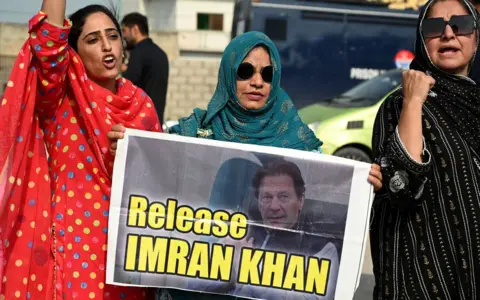
Pakistan's imprisoned former prime minister Imran Khan hasn't had any visitors in over five weeks according to his party, who allege that the military chief, Field Marshall Asim Munir, is obstructing communications to silence Khan's political discourse. The government's counterclaim attributes the cessation of meetings to Khan's violation of jail regulations prohibiting political discussions.
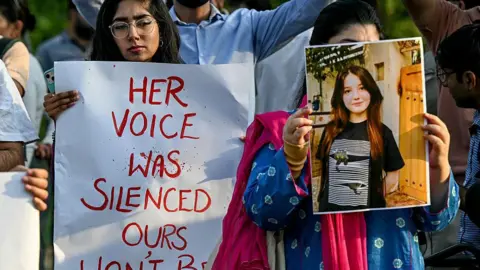
Khan's situation illustrates a broader trend within Pakistan, where journalists, analysts, and human rights advocates report a shrinking space for dissent amid tightening governmental controls. As the country grapples with increasing authoritarianism, recent cases include human rights lawyer Imaan Mazari, who, alongside her husband, was convicted of sharing anti-state sentiments on social media, resulting in a ten-year prison sentence.
Amnesty International has called for an end to the 'coercive tactics' used to subdue dissent, arguing that such actions epitomize the military's growing influence over political discourse in Pakistan.
Supporters of Khan claim that the military is trying to erase him from public memory, with family members stating that it is becoming taboo to discuss him positively or the military chief negatively in media spaces. Khan has reportedly been denied visits from family and legal representation for extended periods, raising concerns over his rights in confinement.
While Khan may be the most visible victim, he is not alone in facing state suppression. Several activists have been sentenced for speaking out, and journalists have reported self-censorship due to threats and intimidation, indicating an environment hostile to free expression. Concerns about the judiciary being used as a tool against dissenters are increasingly pronounced, leading to fears that Pakistan may be on the verge of veering into a more oppressive regime.
Recent constitutional amendments that granted lifetime immunity to military leadership further exacerbate fears of unchecked power, as voices critical of the military or government continue to be silenced. Observers note that the current repression, although not new, has adopted more institutionalized mechanisms that signal a dangerous escalation in Pakistan's political landscape.
Khan's situation illustrates a broader trend within Pakistan, where journalists, analysts, and human rights advocates report a shrinking space for dissent amid tightening governmental controls. As the country grapples with increasing authoritarianism, recent cases include human rights lawyer Imaan Mazari, who, alongside her husband, was convicted of sharing anti-state sentiments on social media, resulting in a ten-year prison sentence.
Amnesty International has called for an end to the 'coercive tactics' used to subdue dissent, arguing that such actions epitomize the military's growing influence over political discourse in Pakistan.
Supporters of Khan claim that the military is trying to erase him from public memory, with family members stating that it is becoming taboo to discuss him positively or the military chief negatively in media spaces. Khan has reportedly been denied visits from family and legal representation for extended periods, raising concerns over his rights in confinement.
While Khan may be the most visible victim, he is not alone in facing state suppression. Several activists have been sentenced for speaking out, and journalists have reported self-censorship due to threats and intimidation, indicating an environment hostile to free expression. Concerns about the judiciary being used as a tool against dissenters are increasingly pronounced, leading to fears that Pakistan may be on the verge of veering into a more oppressive regime.
Recent constitutional amendments that granted lifetime immunity to military leadership further exacerbate fears of unchecked power, as voices critical of the military or government continue to be silenced. Observers note that the current repression, although not new, has adopted more institutionalized mechanisms that signal a dangerous escalation in Pakistan's political landscape.