In brief
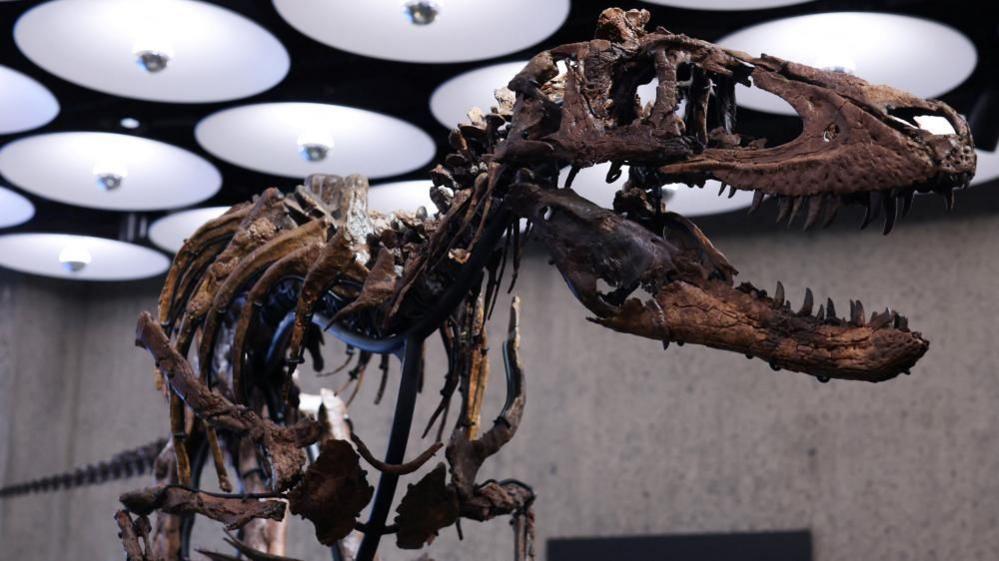
A mounted fossil of the newly confirmed Nanotyrannus, nicknamed ’Jodi’, is being auctioned by Sotheby’s in New York with an expected bid range of $6m to $9m. The sale follows the record $50m auction of a Tyrannosaurus rex named ‘Gus’ and has reignited debate among scientists about whether priceless fossils should remain in public museums. Researchers argue that such high‑value sales could privilege the ultra‑wealthy and limit scientific study, while others note the difficulty of securing funds for public display. The auction highlights tensions between commercial allure and public interest in paleontological heritage.
A rare 10‑foot Nanotyrannus skeleton, nicknamed ’Jodi’, is set for auction by Sotheby’s in New York with an asking price of £4.5m (about $6m).
The auction is scheduled for Tuesday and could drive the final price up to $9m, following the July sale of a Tyrannosaurus rex (‘Gus’) that fetched a record $50m.
’Jodi’ was first displayed at the London Frieze Masters art fair in October 2023, where it was mistakenly identified as a juvenile Tyrannosaurus. Subsequent research in October 2025 confirmed that the specimen belongs to a distinct genus, now recognised as the Nanotyrannus, a predator that lived alongside T. rex around 67million years ago.
The skeleton contains roughly 191 fossil bones and a nearly complete skull, making it one of only three such specimens known to science.
“It was a lot smaller and more gracile, with blade‑like teeth for slicing meat,” explained Megan Jenkins, a palaeontologist. “The differences were clear enough that a separate species was justified.”
Critics worry that high‑value fossil sales could usher in a new era where the ultra‑wealthy own pieces of prehistoric history instead of museums and universities. Professor Steve Brusatte of the University of Edinburgh warned that such sales jeopardise public access and scientific research.
Brusatte compared the potential sale to the Mona Lisa’s removal from public view, saying “I don’t know of any museum or university that can afford a price tag like that.” He added that the auction might inspire future trends that pull other valuable fossils into private hands.
Responding to backlash, Jenkins noted that commercial buyers will likely eventually place specimens in museums. She said, “While the idea of these fossils ending up in a vault is scary, most of the money made during such auctions ultimately helps support future research and public exhibitions.”
Whether or not ‘Jodi’ sells for $9m, the auction underscores the ongoing clash between scientific preservation and the lucrative market for rare fauna.