A meticulously planned military operation, designated "Operation Midnight Hammer," has unfolded as the United States executed an airstrike on Iran's nuclear facilities. Pentagon officials provided a comprehensive briefing detailing the tactics that were utilized during the mission, which involved seven B-2 stealth bombers, mid-air refueling, and tactical decoy flights to obscure the operation's true nature.
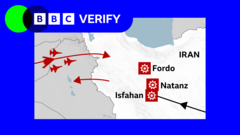
The operation kicked off shortly after midnight, when key U.S. leaders gathered in the Situation Room, including Secretary of Defense Pete Hegseth and President Donald Trump. Under the cover of darkness, the aircraft took off from Whiteman Air Force Base, aiming for Iran's most secure nuclear sites. These raids were crucial for penetrating deep underground facilities such as Fordo, tasked to stifle the country's nuclear program.
Interestingly, the Pentagon revealed that a deception maneuver led to bombers being misdirected toward the Pacific Ocean, diverting attention from the actual trajectory heading straight towards Iran. General Dan Caine described how this move was orchestrated by only a small group of planners.
By 5 p.m. EDT, the B-2 bombers entered the Middle East airspace with protective support aircraft, an endeavor that remained undetected by Iranian air defenses. Satellite images may offer insights into the resulting damage, but the exact timing and impact remain challenging to verify independently.
At 6:40 p.m. EDT, the lead bomber executed a strike with the bunker-buster GBU-57 Massive Ordnance Penetrator, targeting the critical Fordo facility. This mission marked the first live deployment of such advanced munitions, designed to penetrate substantial depth, crucial in targeting the highly fortified sites. Subsequent strikes followed on other nuclear facilities, with the total operation concluding after 18 hours, having engaged the bombers for a concise yet powerful assault over 25 minutes.
In total, the U.S. deployed roughly 75 precision-guided munitions and 125 aircraft in a complex and unprecedented attack strategy. Secretary Hegseth touted the operation as a resounding success aimed at incapacitating Iran's nuclear ambitions, but experts caution that the subsequent evaluation of the strikes may alter perceptions regarding the extent of their effectiveness. Indeed, definitive evidence revealing the damage and the operation's long-term repercussions on Iran's nuclear pursuits will take time to emerge.