
In brief
The Commonwealth summit in Samoa marked a significant shift, with leaders emphasizing the urgency of addressing the transatlantic slave trade's historical injustices, despite the UK remaining firm against financial reparations.
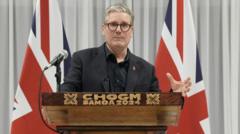
Commonwealth leaders, including UK Prime Minister Sir Keir Starmer, have collectively recognized that "the time has come" to engage in dialogue regarding reparations for the transatlantic slave trade. The debate arises despite Downing Street's attempt to sideline the issue at the recent summit held in Samoa.A document signed by 56 heads of government acknowledges the need for "discussions on reparatory justice," addressing the "abhorrent" legacy of slavery. While no financial discussions took place, the leaders assert the importance of a "meaningful, truthful, and respectful conversation" on the topic. Sir Keir Starmer clarified that although reparations were discussed, no decisions regarding financial compensation were made. "Our position is very clear — the UK will not pay reparations," he stated, reinforcing the government's stance against monetary reparations ahead of the summit.Calls for accountability have intensified, with Commonwealth nations urging the UK to apologize for its historical role in the slave trade and consider reparative measures, which could extend beyond financial compensation to include symbolic or educational actions. Before the conference, UK officials stressed that reparations would not be part of the agenda.During a press conference, Starmer emphasized that the summit's primary focus was on resilience and climate change, with reparations comprising only a small section of the concluding statement. He noted that the conversations surrounding reparations did not dominate the discussions held during the six-hour leaders' conclave.Despite the UK's clear stance, the statement allows Commonwealth leaders advocating for reparations to maintain that the conversation is ongoing. Starmer did, however, indicate that future dialogues on reparatory justice could occur at the upcoming UK-Caribbean forum in March, where a more comprehensive report on the matter is anticipated.Frederick Mitchell, Bahamas' foreign minister, expressed optimism that the UK would eventually consider some form of reparations, reflecting a broader sentiment among Caribbean leaders pushing for accountability. The upcoming meeting in London might serve as a platform for deeper discussions on the reparations narrative.Looking ahead, diplomats anticipate that reparatory justice will feature prominently in future Commonwealth dialogues, especially at the next scheduled summit in two years. Recent estimates from a UN judge suggest that the UK could owe more than £18 trillion in reparations for its involvement in slavery across 14 Caribbean nations.The incoming Commonwealth secretary general, Shirley Ayorkor Botchwey of Ghana, has expressed her commitment to this issue, stressing the importance of collaborative efforts for reparations beyond mere financial compensation. Quotes from her highlights the conviction that significant work lies ahead in addressing historical injustices through reparative measures.
