
In brief
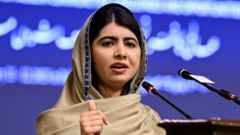
During a recent summit on girls' education in Islamabad, Malala Yousafzai condemned the Taliban's treatment of women, insisting that their actions violate both human rights and Islamic principles, while urging leaders to take a stand against these injustices.
Malala Yousafzai has taken a bold stance against the Taliban’s treatment of women, urging Muslim leaders to confront the oppressive regime during a summit on girls' education in Pakistan. Speaking to attendees in Islamabad, the Nobel Peace Prize winner stated, "Simply put, the Taliban in Afghanistan do not see women as human beings." She criticized the Taliban’s policies—such as banning female education and forbidding women from working—calling them fundamentally incompatible with Islamic values.The 27-year-old advocate, who was shot in the head by a Taliban gunman at the age of 15 for campaigning for girls’ rights, expressed both pride and concern during the summit. Upon her return to Pakistan—her first visit since 2018—Ms. Yousafzai addressed the urgent need to dismantle what she called “a system of gender apartheid” established by the Taliban.She highlighted that women and girls daring to challenge the group’s restrictive laws often face severe repercussions, including violence and imprisonment. "They cloak their crimes in cultural and religious justification, but actually go against everything our faith stands for," she asserted.While the Taliban did not respond to requests for comments regarding Yousafzai’s assertions, they have previously defended their stance by claiming to respect women's rights according to their interpretation of culture and Islamic law. The group was invited to the conference organized by the Organization of Islamic Cooperation (OIC) and the Muslim World League, which they notably chose not to attend.Since reclaiming power in Afghanistan in 2021, the Taliban has received no formal recognition from foreign governments, primarily due to their policies that restrict women’s rights. Afghanistan now holds the distinction of being the only country where women and girls are systematically barred from secondary and higher education. Approximately one and a half million young women have been stripped of their educational opportunities, with no resolution in sight.Concerned about girls' education globally, Yousafzai pointed out crises in regions like Gaza and Yemen, emphasizing that such turmoil jeopardizes the futures of young girls worldwide. She called on attendees to address and condemn the egregious violations against girls’ right to education, underlining that the implications extend far beyond Afghanistan.

