
In brief
Nobel laureate Malala Yousafzai criticizes the Taliban's oppressive policies against women, calling for action from Muslim leaders worldwide.
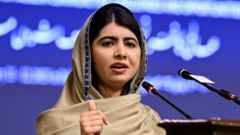
Malala Yousafzai took a strong stance against the Taliban’s treatment of women during a summit focused on girls’ education held in Pakistan. The renowned activist and Nobel Peace Prize winner stated, "The Taliban in Afghanistan do not see women as human beings," as she urged Muslim leaders to confront the oppressive regime. Speaking at the conference in Islamabad, Malala condemned the Taliban's restrictive policies, which prevent girls and women from pursuing education and work opportunities. "There is nothing Islamic about the Taliban's policies," she emphasized.Malala herself knows the dangers of speaking out; she survived an assassination attempt by the Pakistan Taliban when she was just 15, targeted for her advocacy of girls' education. Expressing her feelings upon returning to her home country, she revealed that she was “overwhelmed and happy” to be back, though she was critical of the Taliban's recent establishment of “a system of gender apartheid.” During her address, she highlighted the physical and psychological harm inflicted on women by Taliban enforcement of their laws, claiming they often disguise their actions as cultural or religious mandates, contrary to the teachings of Islam. The Taliban has not publicly responded to her statements, though they have historically claimed to respect women’s rights within their interpretation of Afghan culture and Islamic law.The summit, attended by various ministers and scholars from Muslim-majority nations, sought to advocate for girls’ education across the Islamic world. Notably absent were representatives from the Taliban government, which regained control of Afghanistan in 2021 but has yet to receive formal recognition from any foreign government due to its stringent policies on women’s rights.Malala pointed out that Afghanistan is uniquely positioned as the only nation where women and girls are entirely barred from education beyond the sixth grade, with over one and a half million girls affected. She lamented the loss of access to education, including a recent ban on women training as healthcare workers, effectively cutting off another educational avenue.Furthermore, she raised concerns about women's rights violations in other regions, including Gaza and Yemen. Malala's powerful call to action urged attendees to address the systemic injustices faced by girls in Afghanistan and beyond, ensuring their right to education is never forgotten amidst ongoing crises.
