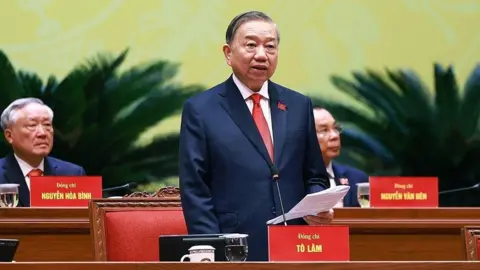
Welcome to the new era of 'national rise'! That was the pitch made by Vietnam's most powerful figure, Communist Party General Secretary To Lam, as he faced the nearly 1,600 delegates at the party congress. On Friday, the congress selected To Lam to continue as party chief, granting him another five years to realize his ambitious targets for Vietnam's economy.
The congress, originally set to end on Sunday, wrapped up early, indicating either a strong consensus or suppressed dissent regarding To Lam's expanding authority. Communist Party congresses are typically meticulously orchestrated, with most leadership roles predetermined prior to the meetings.
Although To Lam's reappointment was anticipated, the ongoing balance of power dynamics between various factions within the party remains uncertain, particularly between To Lam's security faction and the military’s influence.
Edmund Malesky, a political economist at Duke University, remarked on the congress, noting it marks the strongest concentration of power seen in one individual since 1991.
To Lam, who took over after the death of his predecessor Nguyen Phu Trong, shifted the focus from an anti-corruption drive to economic reform and expansion within his first months in power. Proposing a thorough overhaul of administration, he aims to streamline bureaucracy, reduce the number of provinces, and significantly cut government staffing.
The milestone Resolution 68 posits the private sector as a primary economic driver, a stark departure from previous beliefs emphasizing state-owned enterprises. This pivotal change allows for ambitious growth projections, including doubling private businesses by 2030 and establishing a knowledge-based economy by 2045.
His strategy hinges on supporting 'leading cranes'—private firms capable of global competition. While Vietnam's economic evolution has been noteworthy, significant challenges persist, especially regarding state-owned enterprises which still dominate the GDP.
Vietnam counts on overcoming its reliance on foreign investment and low-end manufacturing. The fate of businesses like Vingroup—the most substantial of the national champions under To Lam—will determine whether Vietnam can transition successfully in the global arena.
While VinFast aims for international expansion, its struggles emphasize the difficulty of thriving outside domestic markets, posing questions about the direction of Vietnam's economy under To Lam's ambitious leadership.