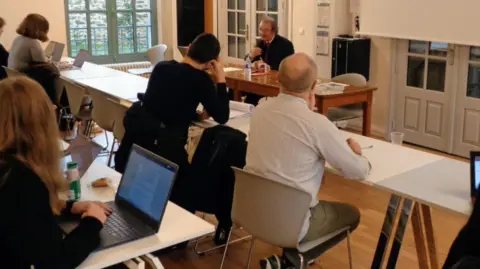
At Sciences Po Saint-Germain, a unique blend of students including aspiring spies and young minds eager for knowledge transforms the traditional classroom into a hybrid training ground for intelligence professionals.
Professor Xavier Crettiez, who leads the course, acknowledges that the real names of many participants remain a mystery, a detail not typical in academia but essential in the realm of espionage.
The university's program, the Diploma of Intelligence and Global Threats, not only trains novice spies but also offers ongoing education for current agents, especially after France's increased commitment to bolster its intelligence capabilities following the 2015 Paris attacks.
The campus, characterized by its discreet architecture and a sense of secrecy, hosts a diverse group of attendees ranging from early 20s students to seasoned government spies. The course includes crucial topics such as organized crime, political violence, and advanced cyber intelligence techniques.
With a tuition cost of €5,000, the course consists of 120 hours of intensive instruction across four months. It aims to equip students with the knowledge to recognize and counteract international threats, making it invaluable to both security agencies and large corporations eager to protect their interests.
Prof Crettiez observes a substantial expansion within French intelligence agencies, now employing about 20,000 agents, and highlights the agency's dual focus: the DGSE for overseas affairs and DGSI for domestic threats, notably in financial crimes driven by organized networks.
The course fosters an environment where current spies network with business professionals, some of whom join to enhance their risk assessment capabilities in global markets.
As interest in intelligence careers grows, especially among women, the course reflects a significant cultural shift, drawing patriotic individuals who seek to contribute positively to national and global security.
In a notable change from the past, the current crop of students exhibits a commitment to their roles that is more pronounced than it was two decades ago.
While modern espionage may not evoke the image of thrilling adventures seen in films, the impact of this educational initiative is poised to shape France's intelligence landscape for years to come.