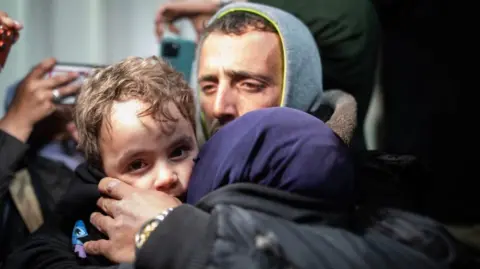
Two Gazan women who passed through the newly reopened Rafah crossing with Egypt on Monday have shared their experiences of extensive checks by a local Palestinian militia linked to Israel. Lamia Rabia described her journey with her children, detailing how they were escorted by Israeli forces to a nearby checkpoint where militia members searched them and their belongings.
'There was a woman from the Abu Shabab group who conducted the searches on the women,' Rabia told BBC reporters. 'They didn't speak with us, they only searched us and then we went to the Israelis, who questioned us.'
The presence of the Abu Shabab militia, identified as an anti-Hamas group that operates under Israeli military control, has raised questions about the coordination between them and the Israeli Defense Forces (IDF). The IDF has not commented on these allegations, nor has Israel's internal security agency, Shin Bet, responded to inquiries.
Rabia also recounted an incident where a member of the militia mentioned that they would assist her in traveling to Europe if she cooperated, alleging that she experienced mistreatment, including being beaten and strip-searched alongside other women.
Support for the militia was further echoed by Ghassan al-Dheini, its leader, who stated his unit's intent to enhance security relating to the crossing. The women interviewed expressed concerns over the treatment and the confiscation of personal items by European officials at the crossing, highlighting the limited number of individuals who made it back to Gaza—only 12 of the 50 expected entered despite prior screening.
The situation at Rafah crossing is emblematic of the broader issues faced by Gazans, with calls for increased international pressure on Israel to ease restrictions and facilitate the passage of patients needing medical care. As new procedures emerge, they signal a tumultuous phase for Gaza, revealing the ongoing struggles and complexities of life amid conflict.