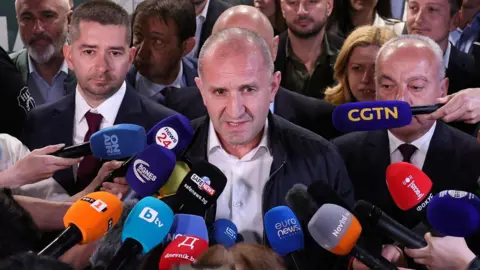
Rumen Radev's Progressive Bulgaria party looks set to win Sunday's Bulgarian Parliamentary election - the eighth general election in five years. Exit polls put his Progressive Bulgaria on 37%, more than double the score of the closest runner-up, former Prime Minister Boiko Borisov's GERB at 16%. Three or four other parties appear poised to cross the 4% threshold and enter Parliament.
The election was called after the previous government attempted to introduce a controversial budget last December, triggering mass protests supported by Radev. People rejected the self-satisfaction and arrogance of old parties and did not fall prey to lies and manipulation. I thank them for their trust, Radev stated in his victory speech, committing to build a strong Bulgaria in a strong Europe.
He highlighted the need for critical thinking and pragmatic actions in Europe, emphasizing Bulgaria's contribution to a new security architecture and industrial competitiveness. Radev, aged 62, is characterized as a pragmatic and somewhat pro-Russian leader, known for criticizing EU sanctions and opposing Bulgarian military support for Ukraine.
Radev’s platform focused heavily on domestic issues, promising to combat corruption and restore a stable government following years of weak coalitions. After stepping down from the presidency in January, he formed his movement to lead the election.
Although his victory is notable, it does not provide Progressive Bulgaria with a strong mandate to govern independently, prompting Radev to seek coalition partners in his first speech post-election.
Amid the ongoing conflict in Ukraine, Bulgaria remains a key supplier of ammunition through intermediaries, enhancing its struggling arms industry. The recent boost in military production includes a partnership with German arms manufacturer Rheinmetall, aiming to optimize the country’s defense capacity despite Radev's opposition to direct military supplies to Ukraine. His administration's approach is expected to mirror that of other Central European leaders, balancing national interests within the EU while supporting domestic production of military equipment.
The election was called after the previous government attempted to introduce a controversial budget last December, triggering mass protests supported by Radev. People rejected the self-satisfaction and arrogance of old parties and did not fall prey to lies and manipulation. I thank them for their trust, Radev stated in his victory speech, committing to build a strong Bulgaria in a strong Europe.
He highlighted the need for critical thinking and pragmatic actions in Europe, emphasizing Bulgaria's contribution to a new security architecture and industrial competitiveness. Radev, aged 62, is characterized as a pragmatic and somewhat pro-Russian leader, known for criticizing EU sanctions and opposing Bulgarian military support for Ukraine.
Radev’s platform focused heavily on domestic issues, promising to combat corruption and restore a stable government following years of weak coalitions. After stepping down from the presidency in January, he formed his movement to lead the election.
Although his victory is notable, it does not provide Progressive Bulgaria with a strong mandate to govern independently, prompting Radev to seek coalition partners in his first speech post-election.
Amid the ongoing conflict in Ukraine, Bulgaria remains a key supplier of ammunition through intermediaries, enhancing its struggling arms industry. The recent boost in military production includes a partnership with German arms manufacturer Rheinmetall, aiming to optimize the country’s defense capacity despite Radev's opposition to direct military supplies to Ukraine. His administration's approach is expected to mirror that of other Central European leaders, balancing national interests within the EU while supporting domestic production of military equipment.