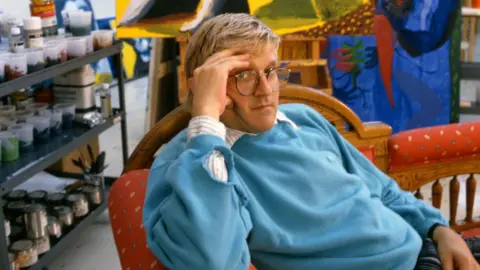
David Hockney, one of Britain’s greatest living artists, died at the age of 88 on 12 June 2026. He will be remembered for his fearless exploration of colour and form, his innovative use of technology and his favourite motifs – the sunny, soaring walls of swimming pools and the rolling Yorkshire countryside.
Born in Bradford on 9 July 1937, Hockney was the youngest of five children. He said the early wartime hardships shaped his resilience, but it was art that captured his imagination. He entered the Royal College of Arts in London in 1955, where, though he faced criticism for refusing to write an essay, he won the coveted Gold Medal and graduated with a relaxed, unorthodox style that broke with tradition.
After leaving England, Hockney spent almost a decade in Los Angeles, where the bright light and open spaces inspired a series of jubilant, saturated canvases. His “A Bigger Splash” (1967) still stands as a landmark, depicting a moment of motion with crystalline clarity, and it remains one of the world’s most celebrated paintings.
Despite his fame, Hockney never ceased to innovate. He embraced Polaroid collages, early digital tools, and later iPad drawings, insisting that technology should serve rather than replace the human hand. Throughout the 1980s and 1990s he returned to painting, crafting projects that were both large in scale and intimate in feeling.
Beyond his canvases, Hockney’s work engaged with social and political themes. He championed gay rights, criticised political policies he deemed oppressive and remained outspoken on issues ranging from the environment to the changing face of the art world.
He is survived by his wife, his long‑time friend, and a legacy of public and private collections that continue to inspire new generations of artists worldwide.