In brief
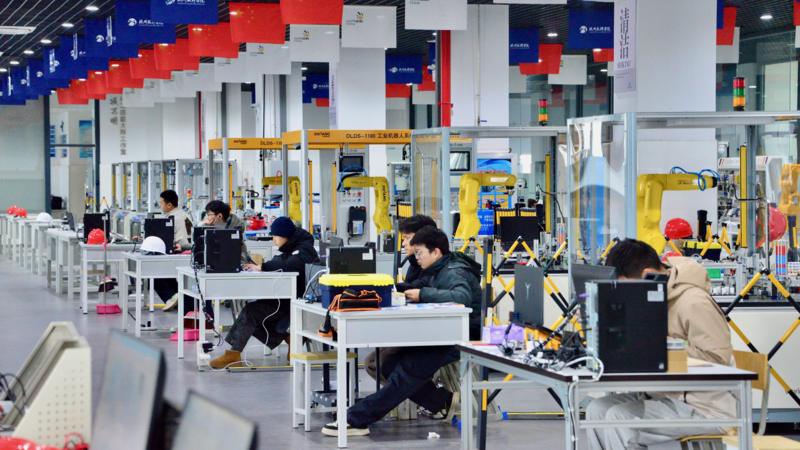
In Hangzhou and Chengdu, students study coding while watching lines of industrial robots load, weld, and assemble parts. China's massive push to automate – part of Xi Jinping’s $20 billion plan – has already brought more than two million robots onto its factories, surpassing any other country. The nation’s vocational institutes are training a new generation of engineers to design and program robots, hoping to offset an ageing workforce and leap ahead in the global AI race.
I take a nap and the world changes, says Chen Tianyu, a 28‑year‑old teacher who spends his spare time touring China’s automated factories. He believes that witnessing robots in action helps him keep his students’ lessons relevant.
In a Hangzhou Technician Institute laboratory, about 30 college students stare at screens while one of them desperately types a line of code to command a robotic arm to pick up a cylindrical piece. “The idea is it will grab that piece and move it over there,” the student explains, eyeing the moving robot.
Before the students, a line of industrial robots sits ready to be programmed. In another part of the classroom, engineers test code for robotic medical instruments, insisting that if a machine isn’t needed by AI and robotics it will soon become redundant.
China’s ambition is clear: a $20 billion push to place the country at the forefront of global innovation and to compete directly with the United States. Hangzhou’s institute, part of a network of purpose‑built vocational schools, trains students from the age of 15 in fields ranging from engines to aeronautics and rare‑earth processing.
Across the country, more than two million robots now work in factories, a figure that outnumbers any other nation. They are assembling cars, electronics and wind‑turbine components, often performing tasks that once required a human hand. The Leapmotor electric‑vehicle factory in Hangzhou exemplifies this, where robots weld, paint, and assemble the chassis while a handful of technicians oversee and fine‑tune the process.
China’s robust manufacturing base supplies the parts for those robots, but the United States still leads in AI “brains,” the software that programs them. Chinese start‑ups, however, are rapidly developing competitive AI models, hinting that the next front in the race will be about deploying intelligence in massive numbers of machines.
Yet the automation boom comes at a time of demographic pressure. By 2035, a third of China’s population will be over 60, and the country could see a net loss of nearly 60 million people in the next decade. Automation is hoped to fill the labor gap before a sluggish economy takes a hit, but rapid transition could also wipe out jobs that humans still perform.
Chen contends that while the impact of these changes remains uncertain, students must adapt to “the technological wave.” He urges them not to stay still but to explore what the future will allow them to do. The Japanese proverb “Living in the past is bad for the future” seems apt for a nation standing on the brink of a robotic renaissance.