In brief
Researchers have uncovered a red hand stencil dated to at least 67,800 years ago in Sulawesi, Indonesia, marking it as the oldest cave painting. This discovery shifts the timeline of human creativity and raises questions about the timing of human migration to the ancient Sahul region. The artifact indicates early symbolic thought, suggesting that creativity emerged much earlier than previously believed, and challenges the Eurocentric view of human artistic development.
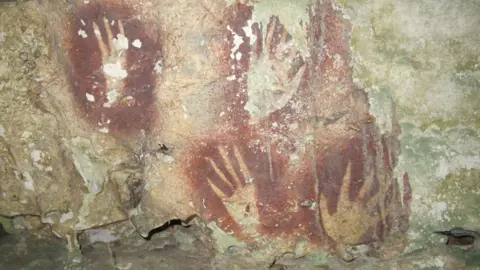
A stencilled outline of a hand found on the Indonesian island of Sulawesi is the world's oldest known cave painting, researchers say.
It shows a red outline of a hand whose fingers were reworked, researchers say, to create a claw-like motif which indicates an early leap in symbolic imagination.
The painting has been dated to at least 67,800 years ago – about 1,100 years older than the previous record holder, a controversial hand stencil in Spain.
This find also strengthens the argument that our species, Homo sapiens, reached the wider Australia–New Guinea landmass, known as Sahul, around 15,000 years earlier than some researchers argue.
Over the past decade, discoveries on Sulawesi have overturned the old idea that art and abstract thinking in our species originated suddenly in Ice Age Europe and spread from there.
Cave art is observed as a key marker for when humans began to think in truly abstract, symbolic ways, the creativity underlying language, religion, and science.
Professor Adam Brumm of Griffiths University in Australia stated that the latest discovery, published in the journal Nature, contributes to the view that human creativity was innate and stretches back to Africa, where we evolved.
There's a significant shift in the perception of human artistic capacity, disrupting the narrative that a creative explosion occurred in Europe. The oldest Spanish cave art is now challenged by this evidence from Sulawesi, with art forms spanning across regions.
This latest discovery comes from a limestone cave called Liang Metanduno on the Muna island, with red hand stencils showing complex artistry indicative of cognitive ability much earlier in human history.
Alignment of findings suggests that humans carried symbolic abilities long before their migration and that the complexity of human creativity is a more ancient trait than previously understood.