
In brief
China's military parade, attended by Xi Jinping, Vladimir Putin, and Kim Jong Un, displayed new weaponry and reaffirmed geopolitical alliances amid rising tensions with the U.S. The display is perceived as a counter-action to the Trump's administration's foreign policy, highlighting a shift towards a new world order driven by military strength and economic cooperation. Experts predict a growing challenge to Western dominance as China's military capabilities continue to modernize at an accelerated pace.
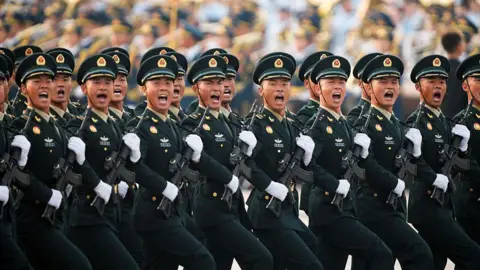
Chinese leader Xi Jinping, alongside Russian President Vladimir Putin and North Korean leader Kim Jong Un, made a symbolic appearance during a military parade on Wednesday, commemorating the 80th anniversary of China's victory over Japan in World War Two. The event was not merely a display of military prowess but a significant political maneuver in the evolving global landscape.
The parade showcased an array of cutting-edge military technology, including new nuclear intercontinental ballistic missiles, hypersonic weapon delivery systems, and even 'robotic dog' drones. This ambitious showcase underscores Xi's aspirations to position China as a formidable player on the world stage, especially in light of the challenges posed by U.S. tariffs and evolving economic policies under Trump's administration.
Four BBC correspondents analyzed the implications of this military display, which not only highlighted China's advancements but also its strategic alliances with countries facing Western sanctions. The optics of this display—Xi greeting his counterparts warmly—capitalized on perceptions of a united front against perceived American hegemonism.
The implications behind Xi's public diplomacy were underscored by a post from Trump on Truth Social, where he accused Xi of conspiring against the U.S. with Russia and North Korea. This evolving geopolitical landscape features an increasingly assertive China, ready to redefine international norms historically shaped by U.S. dominance.
The parade also highlighted China's rapid military modernization, with analysts pointing to advancements in hypersonic missile technology. China's military now stands as a credible rival to the United States, prompting Western leaders to reassess their strategic posture in face of a resurgent China.
As the dynamics shift globally, the response from Western nations is crucial to understanding how the balance of power will evolve. While the parade represented a powerful display of unity among authoritarian regimes, it also reflects underlying tensions that could reshape international relations in the years to come.
