
In brief
At the World Economic Forum in Davos, President Trump made headlines with his audacious comments about tariffs and trade, imploring Canada to consider becoming a U.S. state. His address, viewed by many international leaders and CEOs with a mix of awe and concern, portends significant changes in global economic relations as the world assesses his bold claims of American supremacy.
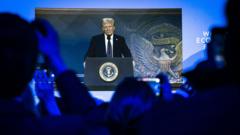
In a striking speech that reverberated across the World Economic Forum (WEF) in Davos, President Donald Trump conveyed an ultimatum to world leaders, suggesting that Canada might need to become a U.S. state to escape impending tariffs. Gathering amid the Swiss Alps, the elite crowd, comprising influential global leaders, businessmen, and a select few celebrities, observed Trump as he articulated his vision of an economic and technological America on the rise. "Nothing will stand in our way," he proclaimed, setting a tone of determination that hinted at a vigorous comeback as he embarks on his second presidential term. Utilising the medium of technology, Trump’s address was transmitted via webcam straight from the White House, ensuring his presence was felt like that of an imposing figure commanding the room.He juxtaposed a compelling narrative about America’s thriving economy with serious threats of tariffs for businesses that failed to relocate production to the United States, illustrating the administration’s 'America First' doctrine. “Your prerogative,” he added, delivering this line with a charisma reminiscent of classic cinematic villains. Noteworthy was a pointed critique directed at Bank of America CEO Brian Moynihan regarding the bank’s treatment of conservative clients, a move that drew murmurs from the audience.The juxtaposition of Trump's evident charm and his contentious proposals underscored a critical moment in international economics, as the global elite weighed the ramifications of his declarations. Canadian officials revealed plans for retaliatory tariffs, while key figures from the UK and EU expressed a desire for peaceful dialogue with the Trump administration, emphasizing the absence of a trade deficit with the U.S. could negate the need for punitive tariffs. Complicating matters, whispers circulated around possible U.S. withdrawal from entities such as the IMF and World Bank, based on Trump’s Project 2025 team’s ambitions. These developments added pressure to immediately reconsider the global trading system and potential cooperative responses.The meeting also displayed the split regarding the growing divides in tech. Despite concerns over economic repercussions from Trump's methods, many were enchanted by his vision, though significant aspects of that narrative were at odds with emerging technologies being developed abroad. The appearance of chieftains from leading tech firms at Davos further attested to America's supremacy, juxtaposed with the stealthy innovations coming out of China that promise to challenge that status.Ultimately, Trump's intentions raised palpable worries among leaders about both the sustainability of the current global trade system and the looming threat of punitive tariffs that may loom over economies worldwide. The question now remains: How will world leaders react to Trump's trademark mix of optimism and aggression as they navigate a new era of economic interaction?
