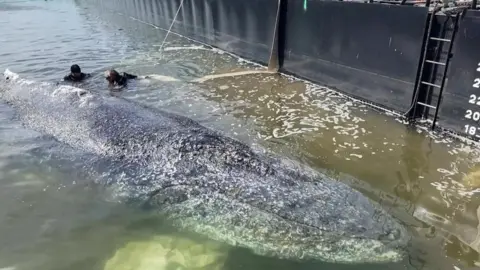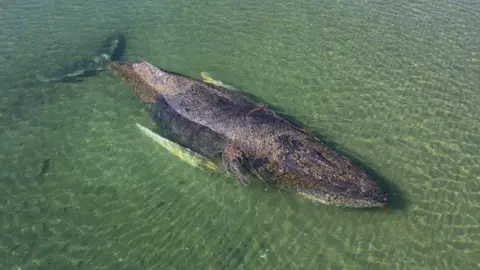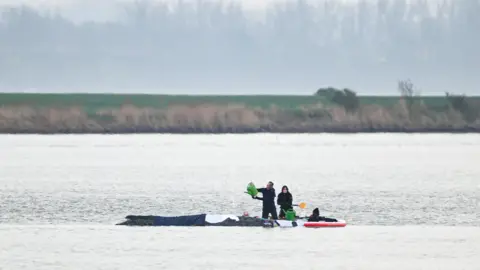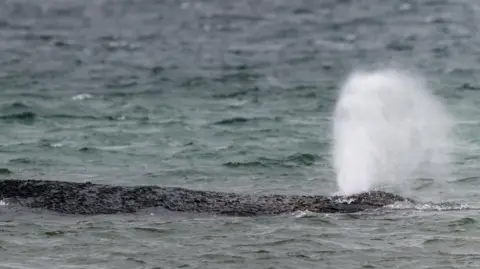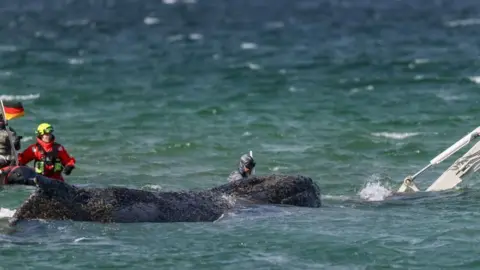
Rescuers are continuing to try and save a stranded humpback whale off Germany's north coast. The marine mammal, which is stuck on a sandbank, was first spotted in Lübeck Bay on Monday. Diggers have been deployed to dredge a channel back into deeper waters. Characterised as a race against time, the rescue mission's attracting huge interest and is even being livestreamed from Timmendorfer Strand, a seaside town in Schleswig-Holstein.
Estimated at being 12 to 15 metres long and weighing 15 tons, it's thought the whale could have previously become entangled in a fishing net, with rope still stuck in its mouth. Experts believe it's a young male that may have accidentally wandered into shallow waters, though the exact reasons leading to its stranding aren't known. Warnings have been issued about the slim chances of saving the whale, but rescuer efforts continue.
For the whale, this is obviously a stressful situation, commented Stephanie Gross from the Institute for Terrestrial and Aquatic Wildlife Research. She noted that the whale has been in shallow waters for three days and isn't feeding at the moment, although such animals can go weeks without food. As conditions on the seashore turn tough with icy easterly winds, divers have been sent to assess the situation more closely. Marine biologist Robert Marc Lehmann remarked on the whale’s poor skin condition but noted that it remains responsive. Despite other efforts to encourage movement failing, hopes persist that the dredged channel will prompt the whale to swim back into deeper waters.
Estimated at being 12 to 15 metres long and weighing 15 tons, it's thought the whale could have previously become entangled in a fishing net, with rope still stuck in its mouth. Experts believe it's a young male that may have accidentally wandered into shallow waters, though the exact reasons leading to its stranding aren't known. Warnings have been issued about the slim chances of saving the whale, but rescuer efforts continue.
For the whale, this is obviously a stressful situation, commented Stephanie Gross from the Institute for Terrestrial and Aquatic Wildlife Research. She noted that the whale has been in shallow waters for three days and isn't feeding at the moment, although such animals can go weeks without food. As conditions on the seashore turn tough with icy easterly winds, divers have been sent to assess the situation more closely. Marine biologist Robert Marc Lehmann remarked on the whale’s poor skin condition but noted that it remains responsive. Despite other efforts to encourage movement failing, hopes persist that the dredged channel will prompt the whale to swim back into deeper waters.