
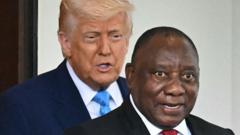
In brief
The US government's distancing from South Africa poses significant challenges for President Ramaphosa as he attempts to mend relations, with potential tariffs on South African goods threatening further economic instability.
The Trump administration has escalated its estrangement from South Africa, treating the nation as a diplomatic outcast and taking steps that threaten to worsen its economic trials. Recent reports from the Democratic Alliance (DA), the second-largest party in South Africa's coalition government, reveal that the US government rejected a diplomatic visa for Ramaphosa's special envoy, Mcebisi Jonas, and has refused to acknowledge him as a legitimate representative. This position was created by Ramaphosa in a bid to salvage relations with the US, which have deteriorated significantly.Ramaphosa's spokesperson dismissed the DA's claims as "disinformation," although no detailed rebuttal was provided. The US State Department, when approached by the BBC, refrained from commenting due to confidentiality regarding visa records. The fallout began after President Trump previously cut aid to South Africa and made incendiary accusations about Ramaphosa’s administration, including allegations of a genocide against white South Africans and concerns over the country's relations with Iran.Experts indicate that if the DA’s allegations are accurate, they align with the Trump administration's broader strategy of sidelining South Africa and obstructing necessary diplomatic dialogue. Bilateral ties have suffered drastic reductions, with the recent boycott of South Africa at global forums like the G20, undermining Ramaphosa’s efforts to promote developing countries' interests.High-profile absences from US events have further showcased the deteriorating relationship—US Treasury Secretary Scott Bessent opted to send a junior representative to the G20 finance ministers meeting in South Africa, mirroring a previous boycott by Secretary of State Marco Rubio. Without the anticipated support from Jonas, whose professional background as a former deputy finance minister and business leader raised hopes for improved diplomatic negotiations, South Africa’s initiative appears stalled.Additionally, Jonas’s earlier comments about Trump, labeling him a "racist" and a "narcissistic right-winger," complicate his ability to foster cooperation. The situation is compounded by potential tariffs on South African exports, which Trump has threatened to impose, a move that analysts warn could trigger considerable job losses, especially in the country’s agriculture sector.Ramaphosa’s government, which historically managed to navigate tensions while maintaining commerce with US administrations, now faces the prospect of substantial economic repercussions from the Trump administration's hostile stance. The looming tariffs could provoke up to 100,000 job losses at a time when South Africa grapples with an unemployment rate of 32.9%. This approach stands in stark contrast to Trump's portrayal of solidarity with Afrikaner farmers, further complicating the narrative.Experts suggest that South Africa may need to diversify its international relationships while navigating the current tension. The Trump administration, reminiscent of prior challenges, is poised to put additional pressure on the South African government unless significant diplomatic shifts occur.

