In brief
Sienna Rose has captivated listeners with her jazz-infused soul music, gathering nearly three million monthly listeners on Spotify. However, evidence suggests that she may not be a real artist. Deezer has flagged many of her songs as AI-generated, and her lack of a social media presence, live performances, and an overwhelming number of releases in a short time have led to widespread speculation about her true identity. This case highlights the broader implications of AI music creation and its impact on the industry.
Sienna Rose is having a good month.
Three of her dusky, jazz-infused soul songs are in Spotify's Viral Top 50. The most popular, a dreamy ballad called Into The Blue, has been played more than five million times.
If she continues on this trajectory, Rose could become one of the year's hottest new stars.
There's only one problem: All the signs indicate she's not real.
Streaming service Deezer, which has developed tools to tackle AI music, told the BBC that many of her albums and songs on the platform are detected and flagged as computer generated.
Look closer and you'll see the indications of an AI artist. Rose has no social media presence, has never played a gig, has no videos, and has released an improbable number of songs in a short space of time.
Between 28 September and 5 December, she uploaded at least 45 tracks to streaming services. Even Prince, an artist known for restless creative mania, would have struggled to match that figure.
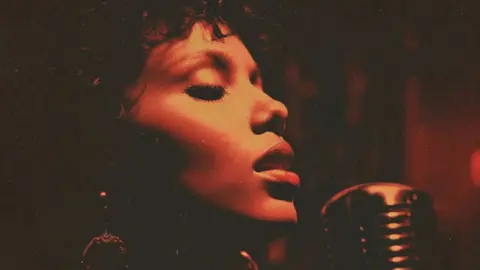
Her Instagram account, which is currently deactivated, featured a strangely homogenous series of headshots, all showing the gauzy, unreal lighting that's characteristic of AI image generators.
Then there's the music itself. Songs like Into The Blue and Breathe Again sit neatly next to Norah Jones or Alicia Keys, full of jazzy guitar lines and buttery smooth vocals.
But many listeners have noted what they have identified as AI artefacts. Play Under The Rain or Breathe Again and you'll hear a telltale hiss running throughout the tracks, typical of music created with certain AI apps.
For casual listeners, there are other signs: inconsistent drum patterns, bland lyrics, and a singer who never strays from the melody or lets rip on the final chorus.
If the mystery of Sienna Rose is indeed a case of AI in the music industry, it raises significant questions about the future of music authenticity, creativity, and the evolving role of AI artists.