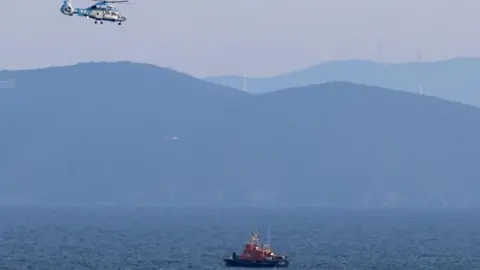
The death of 15 Afghan and Moroccan migrants after a speedboat carrying them collided with a Greek coastguard vessel has been presented by Greek authorities as an open and shut case.
A statement issued late on Tuesday blamed smugglers for failing to comply with the [Hellenic] Coast Guard's visual and audible signals to turn their boat around.
It said the migrant boat was making dangerous manoeuvres before veering into a patrol vessel, off the Chios Strait. The message was that this caused the deaths and the injuries of 24 others who were trying to reach European soil.
But experience tells us to be wary of such instant and unequivocal explanations.
In the summer of 2023, I arrived in the southern Greek port city of Kalamata on the day more than 650 migrants were feared to have drowned. Already, an official Greek narrative had been established that this was a tragedy caused by criminal gangs cramming too many people into an unseaworthy fishing boat.
We were told there was nothing that could have been done to save those onboard, including the estimated 100 women and children who were travelling in the hold of the Adriana.
But survivors then told the BBC that coastguards had caused the migrant boat to capsize following a botched attempt to tow it.
As we returned to Greece to investigate over the following months, more and more contradictions appeared in the official account. Nearly three years on, four senior figures in the Greek coastguard, including its current commander, are among 21 officers now facing criminal prosecution for negligent manslaughter over what was the worst loss of life in the Mediterranean Sea for a decade.
As for Tuesday's fatal incident, near Chios, much of the Greek media has been amplifying the story that the migrant speedboat was manoeuvring dangerously and would not stop.
However, there has so far been no testimony from the survivors to back up or question that account. There is also a lack of independent, third-party evidence that may support the scenario where the packed migrants' boat had deliberately hit the specialist military speedboat.
Any video of the supposed collision could be hugely significant, but it is not clear whether the coastguard was recording its interaction with the migrant boat.
In the case of the Adriana disaster in 2023, the patrol ship involved had been equipped with state-of-the-art, EU-funded, cameras that had been deactivated.
Greece remains a key route for people from the Middle East and elsewhere wanting to reach the European Union. The UNHCR reports that 41,696 people arrived in Greece by sea in 2025, a fall from 54,417 in 2024.
Since 2019, the conservative government of Prime Minister Kyriakos Mitsotakis has pursued a much tougher approach against illegal migration, which has proved popular among voters and was a significant issue in their last election win.
However, human rights groups have consistently accused the Greek coastguard of pursuing dangerous and illegal policies at sea. The Greek government and coastguard deny these accusations, asserting that their actions are within the law.
As this latest incident unfolds, the full truth behind the tragic events remain shrouded in uncertainty, with fears that history may repeat itself regarding migrant tragedies at sea.