
In brief
Germany's coalition government has proposed a military service plan that includes mandatory questionnaires for 18-year-old men and future medical screenings. As the nation seeks to strengthen its defense capabilities, debates surrounding conscription highlight concerns among the youth and the political left, while defense leaders remain optimistic about fulfilling military targets by 2035.
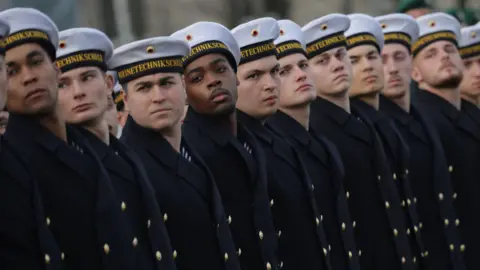
Germany's coalition government has agreed a new military service plan to boost troop numbers following months of wrangling between political forces. The new military service plan will mandate all 18-year-old men to fill out a questionnaire on their suitability to serve and, from 2027, to undergo medical screening. The decision comes as Berlin aims to create Europe's strongest conventional army. The boss of Germany's biggest defence firm, Rheinmetall, has told the BBC he believes that target could be met in five years.Armin Papperger said Chancellor Friedrich Merz's aim to boost the Bundeswehr was 'realistic' and he told the BBC that 'clear decisions' were coming from government. Earlier this year German defence chief Gen Carsten Breuer warned that the Western Nato alliance had to prepare for a possible Russian attack within four years. Mr Papperger said he had 'no glass ball' about the future but agreed Germany had to be 'ready in '29'.When they formed a coalition earlier this year, Merz's conservative CDU/CSU and the centre-left Social Democrat SPD agreed to re-introduce military service which would be voluntary 'to start with'. The Bundeswehr currently has around 182,000 troops. The new military service model aims to increase that number by 20,000 over the next year, rising to between 255,000 and 260,000 over the next 10 years, supplemented by approximately 200,000 reservists. From next year, all 18-year-old men and women will be sent a questionnaire to assess their interest and willingness to join the armed forces. It will be mandatory for men and voluntary for women.From July 2027 all men aged 18 will also have to take a medical exam to assess their fitness for duty. If the government's targets are not met, a form of compulsory enlistment could be considered by parliament. If war were to break out, the military would be able to draw on the questionnaires and medical exams for potential recruits. Some within Germany's political left remain deeply opposed to mandatory service. Many young Germans are wary and a significant majority oppose it. A recent Forsa survey for Stern magazine suggested while just over half of respondents favoured compulsory service, opposition rose to 63% among 18- to 29-year-olds. An attack against Germany was an 'unlikely and abstract scenario' that the government was using to legitimise 'stealing millions of young people's right to decide what they should be doing', he said.Meanwhile, 21-year-old Jason signed up as new Bundeswehr recruit earlier this year because of the current 'security situation'. 'I wanted to contribute to defend peace, to defend democracy if the worst happens,' he said. By joining up he felt he was 'giving back to society' but also believed in the deterrent potential of the army, 'so potential enemies don't even think about attacking you'.Defence Minister Boris Pistorius has sought to reassure Germans, saying that despite the new military service plan there was 'no cause for concern... no reason for fear'. 'The more capable of deterrence and defence our armed forces are, through armament through training and through personnel, the less likely it is that we will become a party to a conflict at all,' Pistorius said. Defence spending in Germany tumbled after the end of the Cold War, while conscription was suspended in 2011. Given its past, Germany has long been shy of showing military might, but earlier this year Friedrich Merz announced that the rule for German defence 'now has to be whatever it takes', following Russia's full-scale invasion of Ukraine.
