In brief
The 2026 midterm Senate races are heating up with heated exchanges that cut across party lines. Republican contenders are split over how closely they follow former President Trump, with some endorsing his policies while others distance themselves. Personal attacks—from accusations of anti‑Muslim rhetoric in Michigan to baseless claims in Georgia—flood the debate stage. Meanwhile, 21 of 35 Senate contests have no scheduled debates, with high‑profile candidates taking the stand—or stepping away—to shape their campaigns.
The 2026 U.S. Senate races are becoming a showcase of both party unity and discord. In the run‑up to November 3rd, candidates are polishing their records in high‑stakes debates that are already heated, with several moments that carry more than policy into the spotlight.
Republican Candidates Split Over Trump Support
For many Republicans the question remains: how far does the GOP candidate follow Donald Trump? Two‑thirds of challengers in competitive House and Senate races claim they’ve broken with the former president at least in part. Senator Susan Collins of Maine, a long‑time defender of the GOP, has publicly said she has voted against Trump 137 times and aligned with President Biden 91% of the time. Collins is fighting a tight race against Democrat Troy Jackson and uses her record to appeal to independent and moderate voters.
In a different vein, Congresswoman Ashley Hinson of Iowa was questioned over a deal between the Trump administration and Russia to import hydrocarbons. She replied, “We need to lower gas prices in this country, we need to lower diesel prices, but I don’t think we need to be making a deal with Russia to do it,” while still showing a strong combative posture toward the president’s policies.
Personal Attacks Flood the Debate Stage
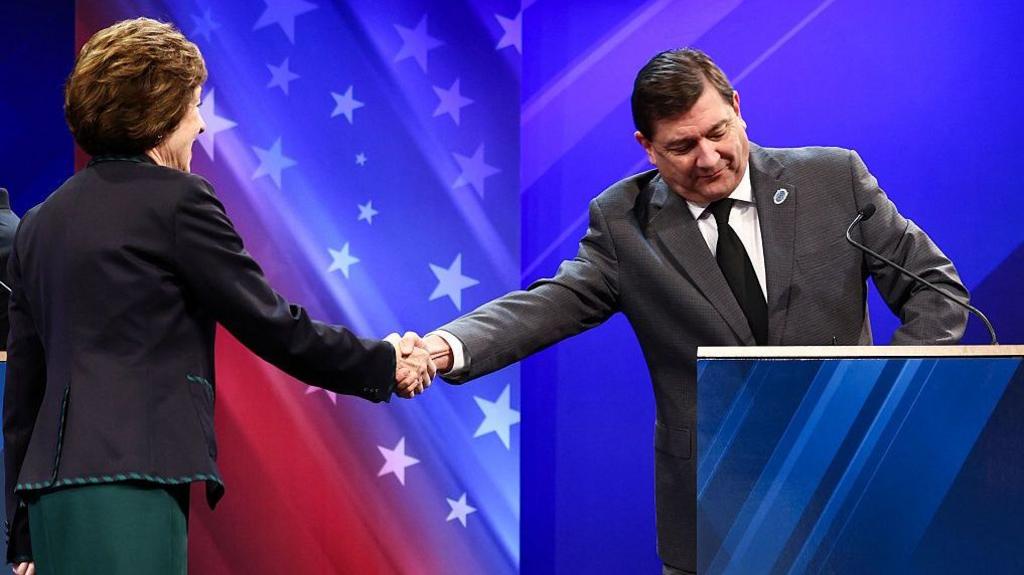
Debates are rapidly turning into personal shoot‑fires. In Michigan’s contest between Democrat Abdul El‑Sayed and Republican Mike Rogers, El‑Sayed accused Rogers of being a “sock puppet” of the Trump administration. Rogers, in turn, questioned whether any of El‑Sayed’s family members were on a security watch list during a heated exchange that climaxed with El‑Sayed calling Rogers “weak” and “cowardly.” A similar drama happened in Georgia, where Senator Jon Ossoff and Representative Mike Collins traded insults, with Ossoff labeling Collins a “bigot” and a “hired member of the Third Reich.”
Some Candidates Skip Debates
While debate battles rage in many districts, 21 of the 35 Senate contests have no scheduled on‑stage fights. Texas’s race, with Democratic state rep. James Talarico and former state attorney general Ken Paxton, is one example; Paxton has declined all invitations to debate despite hints that he might. Analysts caution that skipping a debate removes an opportunity to answer criticism directly and can allow an opponent to frame the narrative unchallenged.
The split between Republican candidates over Trump and the cocktail of personal attacks and debate absences illustrate the volatility of the incoming Senate. As voters face a crowded field of challengers and incumbents, the next weeks in Washington will be pivotal for shaping the political landscape of the United States.