
In brief
Ecuadorian voters have decisively opposed the return of foreign military bases, marking a setback for President Daniel Noboa, who had pushed for constitutional changes to reverse a 2008 ban. The outcome reflects widespread concerns over rising organized crime tied to drug trafficking, yet voters also rejected various proposals aimed at constitutional reform and political funding adjustments. The US had hoped to establish a new base to combat drug trafficking but will need to reassess its strategy following this rejection.
Ecuadoreans have voted against allowing the return of foreign military bases in the country, frustrating US hopes of expanding its presence in the eastern Pacific region.
The referendum result is a blow to Ecuador's President Daniel Noboa, who had campaigned to change the constitution to reverse a ban that the country's legislature passed in 2008.
He had said it would help fight organised crime and reduce the soaring violence the country has seen in recent years, during which it has become one of the world's biggest drug-trafficking hotspots.
The US had hoped the referendum would pave the way to opening a military base in Ecuador, 16 years after it was made to close a site on its Pacific coast.
While Ecuador does not produce cocaine, its huge ports and proximity to Colombia and Peru - where large quantities of the drug are made - make it a desirable and lucrative location for drug-trafficking gangs.
About 70% of the world's cocaine passes through Ecuador, according to Noboa.
His presidency has been defined by a tough military crackdown on criminal gangs, including by putting armed soldiers on the streets. Supporters say his approach has helped to fight crime, but critics say his government has resorted to authoritarian tactics.
The former US military base on Ecuador's Pacific coast was closed after left-wing President Rafael Correa decided not to renew its lease and pushed for the constitutional ban.
US Homeland Secretary Kristi Noem recently toured military facilities in Ecuador with Noboa.
Noboa told the BBC earlier this year that he wanted foreign armies to join what he has described as a war against narco-trafficking groups.
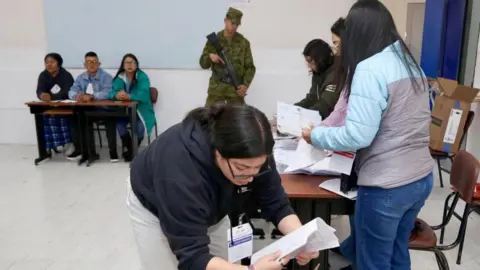
The referendum also saw voters reject ending public funding for political parties, shrinking the size of Congress, and establishing a constitutional assembly to re-write Ecuador's constitution.
Noboa reacted by saying he would respect the outcome of the vote.
On the day of the referendum, the leader of one of Ecuador's biggest drug-trafficking gangs, Los Lobos, was captured in an operation involving Spanish police.
Both Ecuador and the US have designated Los Lobos as a terrorist organisation under domestic law.

