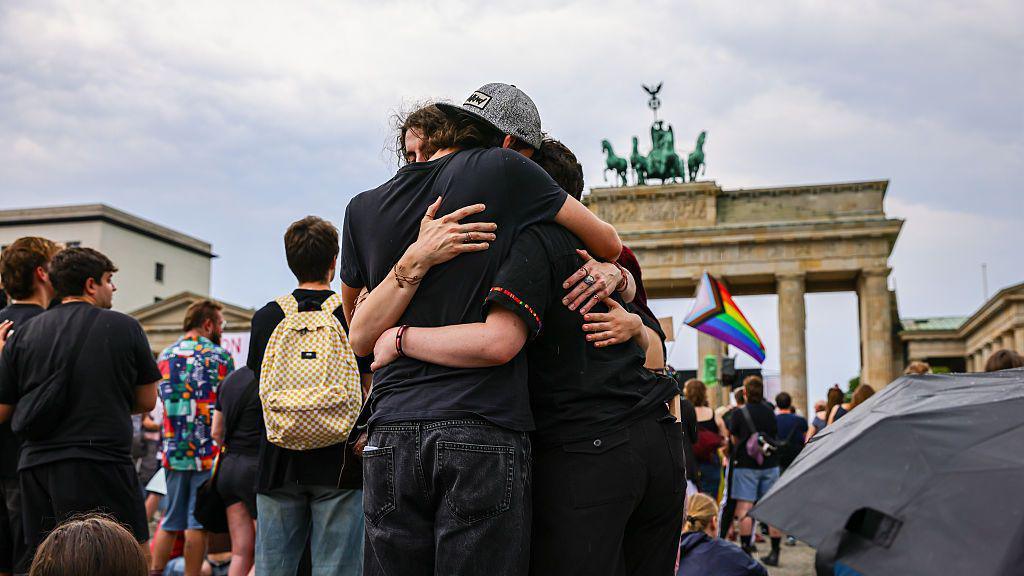
The vehicle that rammed into the Christopher Street Day parade, which took place under the historic Brandenburg Gate, killed a 32‑year‑old Polish woman on Saturday night and wounded at least 29 others, German police said.
Security footage shows the truck, later identified as a suspect vehicle, detorting through crowds and striking unsuspecting demonstrators before being stopped by escapees who fled the scene. The incident has triggered an urgent response from the interior ministry, demanding a full investigation into the attack’s origins and the suspect’s profile.
The main suspect is Abdul Ballout, a 21‑year‑old German citizen with Lebanese heritage. Police shot and killed him on Sunday afternoon during an operation at Spandau, a suburb of Berlin.
Interior Minister Alexander Dobrindt said Ballout “had previously drawn attention to himself through a high volume of criminal offences, radicalisation and affiliation with the Islamist scene.” The minister criticised how no prison sentence was imposed, citing the danger posed by the man.
Ballout’s past has included attempts to join the Islamic State’s armed struggle, travelling through Turkey to Lebanon in 2025. Police arrested him in Lebanon in July, sentencing him to three months for incitement to religious conflict. He returned to Germany in November and was detained at Berlin Brandenburg Airport on pre‑trial charges.
In May, a Berlin court handed Ballout a juvenile sentence of one year and ten months for “pre‑paring a serious act of violence endangering the state.” The sentence was suspended as prosecutors appealed for a longer term, after which Ballout was released under the supervision of a probation officer.
Mayor Kai Wegner of Berlin, a member of the Christian Democrat party, described the judiciary’s handling of Ballout as “dumbstruck” and called for a comprehensive review of how the suspect evaded adjudication.
Some lawmakers, such as Martin Hess of the far‑right Alternative for Germany party, have labelled the attack a “total failure of security policy.” They demanded that independent investigations determine why a known Islamist threat could move freely without administrative caution.
Academic experts, including Peter Neumann of King’s College London, called Germany’s terrorism laws “too lenient” and urged a tighter approach to juvenile justice that balances education with public safety.
Home affairs spokesperson Sebastian Fiedler of the Social Democrats contested the claim that legal frameworks were insufficient, pointing to the gaps in Ballout’s surveillance and the need to analyze his post‑release contact network.
German Chancellor Friedrich Merz declared it too early for definitive policy changes but promised swift, prudent responses. He stressed restricting freedom of movement for classified security threats wherever possible, and requested a review of the monitoring jurisdiction to allow law enforcement to track such individuals effectively.
Police and lawmakers are poised to examine the indictment charge, prison conditions and the broader security framework amid a continuing rise in extremist violence, escalating the call for stronger safeguards and reformed legal processes.