Armenia’s Pashinyan Wins Key Election, Despite Russian Pressure
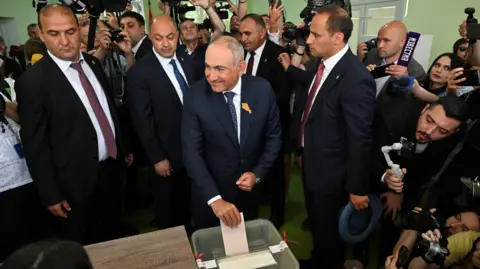
Armenia’s Prime Minister Nikol Pashinyan’s centrist Civil Contract Party secured 49.8 % of the vote, securing a majority in the National Assembly and confirming his push toward closer ties with the West.
The Strong Armenia Alliance came in second with 23.2 % and the Armenia Alliance third at 9.9 %. The Conservative Prosperous Armenia party, led by businessman Gagik Tsarukyan, captured 4 % of the vote.
This election was the first general vote held after Armenia’s crushing defeat in the 2023 war with Azerbaijan, and it was seen as a test of Pashinyan’s policy to deepen Western integration while facing mounting economic pressure from Russia, the country’s largest trading partner.
Pashinyan declared victory early on Monday and said, “Armenian people voted for peace, regional prosperity and cooperation.” He added that the country would continue to pursue rapprochement with the West while maintaining membership in the Eurasian Economic Union.
France and the European Union quickly congratulated Pashinyan, praising Armenia’s step toward closer European ties. In contrast, Russian Foreign Ministry spokesperson Maria Zakharova warned of “unprecedented pressure” on opposition parties and accused the West of interference. She also noted that Armenian society remains “extremely polarised.”
Pashinyan’s domestic support has slipped from 54 % in 2021 to about 30 % in polls ahead of the election, but his party’s narrow victory suggests the electorate remains divided on the country’s direction. Turnout was 59 % across 19 parties and alliances, although only a handful gained parliamentary seats.
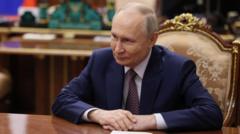
Economic tension with Russia is evident: Russia supplies Armenia with gas at roughly $177.50 per 1,000 cubic metres, while European market prices exceed $600, a gap that president Vladimir Putin highlighted to Pashinyan. In the two weeks before the election, Moscow banned the export of Armenian flowers, mineral water, brandy and fresh produce.
Despite these challenges, Pashinyan has pursued a law to initiate the EU accession process and accelerated a peace plan with Azerbaijan, backed by the United States. He also hosted a EU leaders’ summit and met with Ukrainian President Volodymyr Zelensky in Yerevan earlier this year.
While Armenia is not yet an EU candidate, Pashinyan’s victory signals a continued leaning toward the West amid growing Russian pressure to hold a referendum on either EU membership or remaining in the Eurasian Economic Union.
Public opinion remains split on the peace agreement with Azerbaijan: a recent poll shows 44 % in support, 41 % opposed, reflecting deep national divisions over territorial and security issues.